Agentic AI in the Enterprise: Beyond Chatbots to Autonomous Workflows
The Shift from Chatbots to Agents
Most enterprise AI deployments today follow a simple pattern. A user asks a question, the model generates a response, and the conversation ends. It's useful but limited. The model doesn't take action, doesn't follow up, and doesn't coordinate across systems.
Agentic AI changes that. Instead of responding to a single prompt, an AI agent can break down complex tasks, decide which tools to use, execute multi-step workflows, and iterate on its own outputs until the job is done. The difference between a chatbot and an agent is the difference between asking someone a question and giving someone a project.
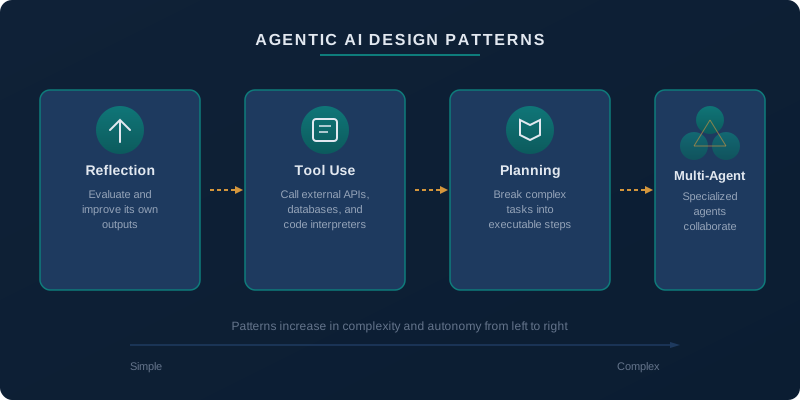
Andrew Ng has outlined four design patterns that define agentic behavior: reflection (the model evaluates and improves its own output), tool use (the model calls external systems like APIs, databases, and code interpreters), planning (the model breaks a complex task into steps), and multi-agent collaboration (multiple specialized agents work together on different parts of a problem).
These aren't theoretical patterns. They're being deployed in production today, and enterprises that understand them have a significant head start.
What Agents Actually Look Like in Practice
The use cases for agentic AI in the enterprise are more practical than futuristic.
Customer service escalation. Instead of a chatbot that can only answer FAQs, an agent can look up the customer's account, check order status, initiate a return, send a confirmation email, and escalate to a human only when the issue falls outside its capabilities. The customer gets a resolution, not a suggestion to call support.
Code review and development. An agent can receive a feature request, search the codebase for relevant patterns, write implementation code, run tests, fix failures, and submit a pull request for human review. The developer reviews and approves rather than writing everything from scratch.
Procurement and vendor management. An agent can analyze purchase requests against approved vendor lists, compare pricing across suppliers, flag compliance issues, draft purchase orders, and route them for approval. What previously took a procurement specialist hours of manual work happens in minutes.
Data analysis and reporting. An agent can receive a business question, determine which data sources to query, write and execute SQL, analyze the results, generate visualizations, and draft a summary with key findings. Analysts spend their time on interpretation and decision-making rather than data wrangling.
The Governance Challenge
Agentic AI introduces governance questions that are fundamentally different from those posed by traditional AI or even simple chatbots.
Autonomy boundaries. How much should an agent be allowed to do without human approval? An agent that sends emails on behalf of the company, modifies production databases, or commits code to repositories is taking real-world actions with real consequences. Defining clear boundaries for what an agent can do autonomously versus what requires human confirmation is critical.
Accountability. When an agent makes a mistake (and they will), who is responsible? The developer who built the agent? The team lead who approved its deployment? The user who triggered the workflow? Your governance framework needs clear accountability chains for agentic systems.
Auditability. Every action an agent takes should be logged in a way that allows full reconstruction of its reasoning and decision path. This is essential for debugging, compliance, and building trust with stakeholders who are understandably cautious about autonomous systems.
Cost control. Agents that can call tools and iterate on their outputs can consume significant compute resources, especially if they get stuck in loops or take inefficient paths. Set hard limits on execution time, token usage, and tool invocations per task.
Building Agents That Are Safe to Deploy
Based on what we're seeing across enterprise deployments, here are the practices that distinguish successful agent implementations from problematic ones.
Start with human-in-the-loop. Don't deploy fully autonomous agents on day one. Start with agents that propose actions and wait for human approval before executing. As you build confidence in the agent's judgment, gradually expand its autonomous capabilities for low-risk actions while keeping human approval for high-risk ones.
Constrain the tool set. Give agents access only to the tools they need for their specific task. An agent that handles customer service inquiries doesn't need write access to your production database. The principle of least privilege applies here just as it does in traditional security.
Implement circuit breakers. Build mechanisms that automatically stop an agent if it exceeds defined limits (number of steps, execution time, number of errors, or cost thresholds). Agents that can't stop themselves are a liability.
Test adversarially. Agentic systems inherit all the vulnerabilities of the underlying LLMs (prompt injection, hallucination, sensitive data exposure) plus new ones created by tool access. If an attacker can manipulate the agent's reasoning through injected content in documents or emails it processes, they can potentially trigger real-world actions. Red-team your agents specifically for these scenarios.
Monitor in production. Log every agent action, tool call, and decision point. Build dashboards that show agent success rates, failure modes, and average cost per task. Treat agent monitoring with the same rigor you'd apply to any critical production system.
The Technology Landscape
The tooling for building enterprise agents is maturing rapidly. Frameworks like LangGraph, CrewAI, and AutoGen provide the orchestration layer. Cloud providers are adding agent-specific services. And the underlying LLMs are getting better at the reasoning and planning capabilities that make agents work.
But the tooling is evolving fast, and locking into a specific framework too early carries risk. Focus on clean abstractions between your agent logic, tool integrations, and the underlying model. This gives you the flexibility to swap components as the ecosystem matures.
Moving Forward
Agentic AI represents a genuine step change in what enterprises can automate. But the step from "AI that answers questions" to "AI that takes actions" requires a corresponding step up in governance, security, and operational practices.
Start with a well-defined, bounded use case. Deploy with human-in-the-loop oversight. Measure everything. And expand the agent's autonomy only as you build evidence that it performs reliably and safely.
The organizations that get this right will automate workflows that were previously too complex, too variable, or too judgment-dependent for traditional automation. That's a meaningful competitive advantage.
Want to discuss this topic?
Book a free consultation with our team to explore how these insights apply to your organization.