How to Build an AI Governance Framework That Actually Works
Governance Can't Wait
Two years ago, AI governance was a nice-to-have that forward-thinking organizations discussed at conferences. Today it's a regulatory requirement in the EU, an active area of legislation in the US, and a due diligence item for enterprise customers evaluating AI-powered vendors.
The NIST AI Risk Management Framework (AI RMF 1.0) and the EU AI Act have established clear expectations for how organizations should develop, deploy, and monitor AI systems. Whether your enterprise is building AI products or purchasing AI tools, you need a governance framework that demonstrates responsible use.
But governance that slows everything to a crawl defeats the purpose. The goal is a framework that provides meaningful oversight without killing the speed of innovation.
The Three Pillars
An effective AI governance framework rests on three pillars: policy, process, and people. Miss any one of them and the framework falls apart.
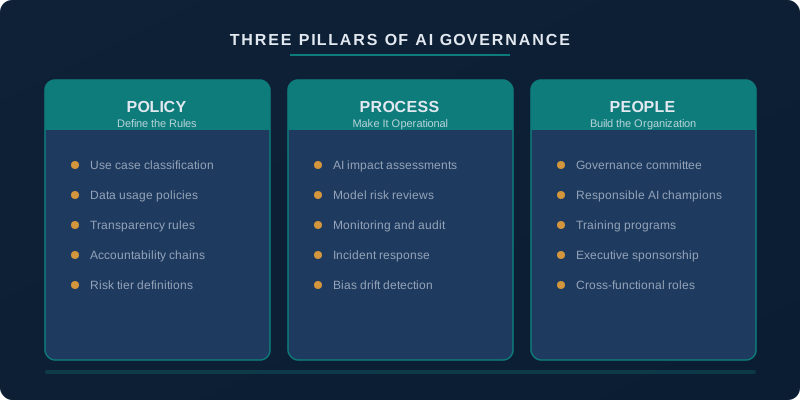
Policy: Define the Rules
Your AI governance policies establish the boundaries for how AI can and cannot be used within your organization. These don't need to be lengthy legal documents. They need to be clear, specific, and enforceable.
Use case classification. Not all AI use cases carry the same risk. A model that recommends internal meeting times is fundamentally different from one that approves loan applications. Borrow from the EU AI Act's risk-tiering approach: classify use cases as minimal risk, limited risk, high risk, or unacceptable risk. Each tier gets different governance requirements.
Data policies. What data can be used for AI training and inference? How is personally identifiable information handled? What are the rules for using synthetic data, public data, and third-party data? These questions need explicit answers before projects start, not ad hoc decisions made mid-development.
Transparency requirements. When should users be told they're interacting with an AI system? What level of explainability is required for automated decisions? This varies by use case and jurisdiction, so your policies should be specific about requirements for each tier.
Accountability. Who is responsible when an AI system produces a harmful outcome? Your policies should clearly assign accountability for every AI system in production.
Process: Make It Operational
Policies without processes are just documents nobody reads. The governance process is what makes the policies operational.
AI impact assessments. Before any AI project moves from prototype to production, it should go through a structured assessment that evaluates potential harms, fairness implications, privacy risks, and security concerns. Make this lightweight for low-risk applications and thorough for high-risk ones.
Model risk management. Establish a review process for models before deployment. This includes validation of training data quality, evaluation of model performance across different demographic groups, stress testing under adversarial conditions, and sign-off from appropriate stakeholders.
Monitoring and audit. Production AI systems need continuous monitoring for performance degradation, bias drift, data quality issues, and security anomalies. Schedule periodic audits that review whether systems still meet the standards they were deployed under. Models don't stay static, and neither should your oversight.
Incident response. Define what constitutes an AI incident (biased output, data leak, model failure, adversarial attack) and establish clear escalation procedures. This should integrate with your existing security incident response process, not exist as a separate workflow.
People: Build the Organization
Governance doesn't run itself. You need people with the right authority, skills, and incentives.
AI governance committee. A cross-functional group including representatives from engineering, legal, compliance, risk, and business. This committee reviews high-risk use cases, resolves disputes about governance requirements, and updates policies as the landscape evolves. Keep it small (5 to 8 people) to maintain decision-making speed.
Responsible AI champions. Embed governance awareness within development teams by designating responsible AI champions who understand both the technical and ethical dimensions. They serve as the first line of governance review and escalate issues that need committee attention.
Training. Everyone building or deploying AI needs baseline training on your governance framework, relevant regulations, and the specific risks associated with AI systems. This isn't a one-time onboarding module. It needs to be updated as regulations, technology, and your own policies evolve.
Balancing Governance with Speed
The most common objection to AI governance is that it slows things down. And poorly designed governance absolutely does. Here's how to avoid that.
Tier your requirements. A low-risk internal tool should not go through the same review process as a model making credit decisions. Design your governance process with multiple tracks based on risk classification.
Automate where possible. Data quality checks, bias evaluations, and security scans can be built into your ML pipeline and run automatically. Manual review should be reserved for judgment calls that genuinely require human evaluation.
Set time limits. Governance reviews should have SLAs. If the governance committee doesn't respond within five business days, the review is automatically approved at the requested risk level. This creates accountability on both sides.
Make governance a design input, not a gate. When teams understand the governance requirements upfront (before they start building), they design compliant systems from the beginning. This is much faster than building first and retrofitting governance after.
Learning from the EU AI Act
Even if your organization isn't directly subject to the EU AI Act, its framework provides useful structure.
The Act categorizes AI systems into risk tiers with proportional requirements. Unacceptable risk applications (social scoring, real-time biometric surveillance in public spaces) are banned. High-risk applications (hiring, credit, healthcare) require conformity assessments, documentation, and human oversight. Limited-risk applications require transparency notices. Minimal-risk applications have no specific requirements.
This tiered approach is practical and transferable. Adopt a similar classification for your internal governance even if EU regulations don't apply to you. It gives teams a clear, predictable framework for what's expected.
Getting Started
You don't need a perfect framework to start. You need a working one.
- Classify your existing AI use cases by risk level.
- Write policies for data use, transparency, and accountability.
- Implement a lightweight review process for new AI projects.
- Assign a small governance committee.
- Monitor production systems and schedule quarterly audits.
Iterate from there. Governance frameworks mature alongside the AI programs they govern. The important thing is to have the structure in place so that oversight keeps pace with deployment, rather than falling further behind with every new project.
Want to discuss this topic?
Book a free consultation with our team to explore how these insights apply to your organization.