Build vs. Buy vs. Fine-Tune: An Enterprise Decision Framework for LLMs
The Decision Every Enterprise Is Facing
Large language models have moved from research curiosity to enterprise tool faster than almost any technology in memory. But the "how do we adopt this?" question is proving harder than the "should we?" question.
The options are deceptively simple: buy access to a commercial API (OpenAI, Anthropic, Google), fine-tune an open-weight model (Llama, Mistral, Qwen) on your own data, or train a custom model from scratch. In practice, the right answer depends on factors that most organizations haven't fully evaluated.
Stanford HAI's Foundation Model Transparency Index and Gartner's Hype Cycle for AI both highlight that enterprise LLM adoption is still in the early stages, and many organizations are making this decision without a clear framework. Here's one that works.
Option 1: Buy (Commercial API)
Using a commercial LLM through an API (GPT-4, Claude, Gemini) is the fastest path to production. You don't manage infrastructure, training, or model updates. You send prompts, get responses, and pay per token.
Best when:
- You need to move quickly and validate an idea before committing to infrastructure.
- Your use case doesn't require the model to know domain-specific information that isn't in its training data.
- Data sensitivity allows sending prompts to a third-party provider.
- You want access to the most capable models without the cost of training or hosting them.
Watch out for:
- Cost at scale. API pricing is reasonable for prototyping but can become expensive for high-volume production use cases. A customer support chatbot handling 100,000 conversations per month can easily cost tens of thousands in API fees.
- Data privacy. Your prompts and potentially sensitive data are being sent to an external provider. Enterprise data processing agreements help, but some industries and use cases require the data to never leave your infrastructure.
- Dependency. You're relying on the provider's uptime, model updates, and pricing decisions. Model versions get deprecated. Pricing changes. Behavior can shift between model updates in ways that affect your application.
- Limited customization. You can steer the model through prompting and retrieval-augmented generation (RAG), but you can't change its fundamental behavior or knowledge.
Option 2: Fine-Tune (Open-Weight Model)
Fine-tuning takes a pre-trained open model and trains it further on your specific data to improve its performance on your particular tasks. Models like Llama 3, Mistral, and Qwen provide strong foundations that can be specialized with relatively modest compute.
Best when:
- Your use case requires domain-specific knowledge or terminology that the base model handles poorly.
- You need consistent, predictable behavior for a defined set of tasks (classification, extraction, summarization within a specific domain).
- Data privacy requirements mean the model and data must stay on your infrastructure.
- You want to reduce inference costs by using a smaller, specialized model instead of a large general-purpose one.
Watch out for:
- Data requirements. Fine-tuning requires high-quality, labeled training data specific to your domain. Gathering and cleaning this data is often the most time-consuming and expensive part of the project.
- Ongoing maintenance. Models degrade as the world changes and your data evolves. You need a pipeline for continuous fine-tuning, evaluation, and deployment.
- Infrastructure. You'll need GPU infrastructure for both training and inference. This can be cloud-based, but it's still your responsibility to provision, monitor, and manage.
- Evaluation rigor. Measuring whether fine-tuning actually improved performance requires well-designed evaluation benchmarks. Without them, you might be spending significant resources for marginal gains.
Option 3: Build (Train from Scratch)
Training a foundation model from scratch means starting with raw text data and building the model architecture, training pipeline, and evaluation framework yourself.
Best when:
- Almost never, for most enterprises.
That's not flippant. Training a competitive LLM from scratch requires millions of dollars in compute, massive curated datasets, and a team with deep expertise in distributed training systems. This option makes sense for AI research labs and a handful of very large technology companies. For virtually every other organization, fine-tuning or using commercial APIs is a better allocation of resources.
The exception is training small, task-specific models (not foundation models) for well-defined problems like fraud detection, recommendation, or classification. These are traditional ML models, not LLMs, and building them in-house is often the right approach when you have the data and expertise.
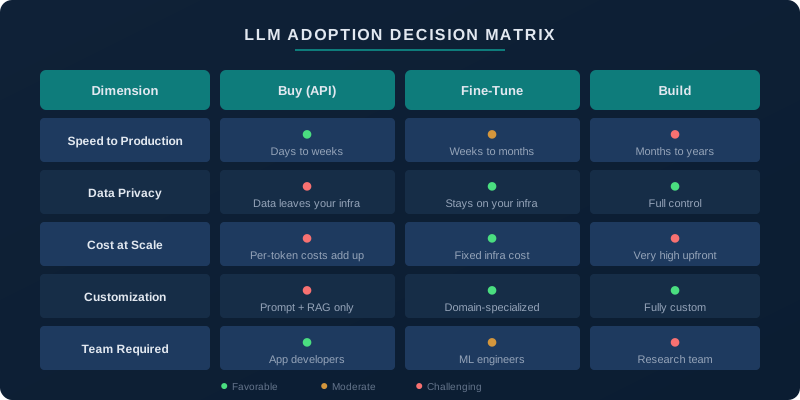
The Decision Matrix
Here's a practical framework for evaluating your options:
Data sensitivity. If your data can never leave your infrastructure, that rules out most commercial APIs for anything beyond non-sensitive use cases. Fine-tuning on-premises or in your own cloud environment becomes the baseline.
Task specificity. General-purpose tasks (summarization, translation, question answering on public knowledge) work well with commercial APIs. Highly specific tasks (classifying insurance claims using your company's taxonomy, generating code in your proprietary framework) benefit from fine-tuning.
Volume and cost. Low to moderate volume? Commercial APIs are cost-effective. High volume on well-defined tasks? A fine-tuned smaller model running on your own infrastructure will likely be cheaper in the long run.
Speed to production. Need something working this quarter? Start with a commercial API. Building a differentiated capability over the next year? Invest in fine-tuning.
Competitive differentiation. If the AI capability is core to your product and a source of competitive advantage, owning the model (through fine-tuning) gives you more control. If AI is augmenting internal operations, commercial APIs are fine.
The Hybrid Reality
Most enterprises end up using a combination of all three approaches. Commercial APIs for rapid prototyping and general-purpose tasks. Fine-tuned models for high-volume, domain-specific workloads. And traditional ML for well-defined prediction and classification problems.
The key is matching the approach to the use case rather than picking one strategy and applying it everywhere. A customer-facing chatbot might use a commercial API with RAG. An internal document classifier might run on a fine-tuned open model. A fraud detection system might use a custom-trained traditional ML model.
Total Cost of Ownership
Whichever path you choose, make sure you're accounting for the full cost:
- Commercial API: Token costs, integration development, prompt engineering effort, and the risk of price changes.
- Fine-tuning: Training data preparation, GPU compute for training and inference, MLOps infrastructure, ongoing retraining, and specialized talent.
- Custom training: All of the above, multiplied significantly, plus the opportunity cost of what your team could be building instead.
The most common mistake we see is enterprises comparing only the direct costs (API fees vs. GPU bills) and ignoring the operational overhead of self-hosted models or the hidden costs of API dependency.
Making the Call
Start by clearly defining the use case, data sensitivity requirements, expected volume, and strategic importance. Run that through the decision matrix above. For most initial enterprise LLM projects, the answer will be to start with a commercial API, validate the use case, and then evaluate whether fine-tuning makes sense as you scale.
The important thing is to make the decision deliberately rather than defaulting to whatever your team is most excited about.
Want to discuss this topic?
Book a free consultation with our team to explore how these insights apply to your organization.