Data Mesh vs. Data Lakehouse: Choosing the Right Architecture for Your Enterprise
The Architecture Decision That Defines Your Data Future
If you're a data leader evaluating your enterprise's data architecture in 2025, two paradigms keep coming up in every conversation: data mesh and data lakehouse. Both promise to solve real problems. Both have passionate advocates. And both can fail spectacularly if adopted for the wrong reasons.
The truth is that these aren't competing architectures so much as different answers to different organizational problems. Understanding which problem you're actually solving is the key to making the right choice.
What Data Mesh Actually Is
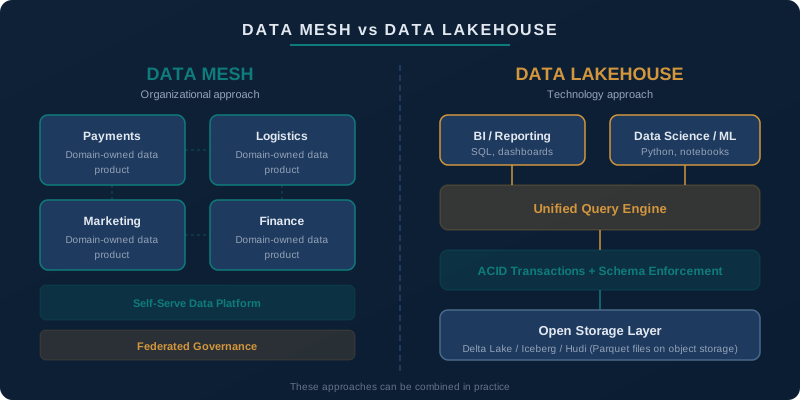
Data mesh, originally articulated by Zhamak Dehghani at Thoughtworks, is fundamentally an organizational approach to data, not a technology choice. It's built on four principles.
Domain ownership. Instead of a centralized data team owning all data, each business domain (payments, logistics, marketing) owns and manages the data it produces. The people closest to the data are responsible for its quality and availability.
Data as a product. Domain teams treat their data outputs like products, with clear documentation, SLAs, quality guarantees, and versioning. Consumers of that data should be able to discover and use it without needing to understand the producing system's internals.
Self-serve platform. A central platform team provides the tools and infrastructure that domain teams use to publish, discover, and consume data products. Think of it as an internal developer platform, but for data.
Federated governance. Governance standards are set centrally but enforced locally by domain teams. This balances consistency with autonomy.
Data mesh works best in large organizations with mature engineering cultures, multiple autonomous business units, and a history of centralized data teams becoming bottlenecks. If your data engineers are spending most of their time fielding requests from other teams rather than building, mesh addresses that structural problem.
What Data Lakehouse Actually Is
The lakehouse architecture, popularized by Databricks and built on open formats like Delta Lake, Apache Iceberg, and Apache Hudi, solves a different problem entirely.
Traditionally, enterprises maintained separate data lakes (cheap storage, flexible schema, good for data science) and data warehouses (structured, performant, good for BI and reporting). Keeping them in sync was expensive and error-prone. Data got copied, transformed, and reconciled across systems, creating inconsistencies.
The lakehouse unifies these into a single storage layer that supports both workloads. You get the flexibility of a data lake with the performance, ACID transactions, and schema enforcement of a data warehouse.
This matters because it eliminates the duplication, reduces data movement, and gives data scientists and business analysts access to the same underlying data without the reconciliation headaches.
The Decision Framework
Here's how to think about which architecture fits your situation.
Choose data mesh when:
- Your organization is large (hundreds or thousands of engineers) with distinct business domains
- Centralized data teams have become a bottleneck and can't keep up with requests
- Domain teams have the engineering maturity to own and operate their own data products
- Your primary challenge is organizational, not technological
Choose lakehouse when:
- Your primary challenge is managing the complexity and cost of separate lake and warehouse systems
- You need to support both BI/reporting and data science/ML workloads on the same data
- Your organization is mid-sized and a centralized data team can still serve the business effectively
- You want to reduce data duplication and simplify your storage architecture
Consider both when:
- You're a large enterprise where different domains could produce data products (mesh) stored on a unified lakehouse platform. These approaches aren't mutually exclusive, and many mature organizations end up combining elements of both.
Common Mistakes
Adopting mesh too early. Data mesh introduces significant organizational complexity. If your company has 50 engineers and one data team, mesh is overkill. The coordination overhead of federated ownership will slow you down rather than speed you up.
Treating lakehouse as just a technology upgrade. Migrating from a traditional warehouse to a lakehouse without rethinking your data modeling, quality practices, and access patterns often reproduces the same problems in a new platform.
Ignoring the people side. Both architectures require cultural change. Mesh requires domain teams to take on data responsibilities they may not want. Lakehouse consolidation may eliminate roles or require reskilling. The organizational change management is as important as the technical migration.
Where the Industry Is Heading
Gartner's data management hype cycle positions both approaches as moving toward mainstream adoption, with lakehouse slightly ahead in maturity. The practical reality we see across enterprise engagements is convergence. Organizations adopt lakehouse as the storage and compute foundation, then layer mesh-inspired practices (domain ownership, data products, federated governance) on top as they scale.
This hybrid approach acknowledges that you need both a solid technical platform and an organizational model that scales. Starting with one and growing into the other is a perfectly valid strategy.
Making Your Choice
Map your architecture decision to your actual bottlenecks. If your data team is overwhelmed and domains are waiting weeks for access to data, investigate mesh principles. If you're drowning in infrastructure complexity with data spread across lakes, warehouses, and various processing engines, the lakehouse consolidation story is compelling.
Either way, start with a clear picture of what's not working today. The best architecture is the one that solves the problem you actually have.
Want to discuss this topic?
Book a free consultation with our team to explore how these insights apply to your organization.