The Enterprise Data Quality Problem: Why Your AI Models Are Only as Good as Your Data
The Hidden Tax on AI
Every enterprise investing in AI eventually hits the same wall. The models don't perform as expected. Not because the algorithms are wrong or the infrastructure is inadequate, but because the underlying data is fundamentally flawed.
Gartner estimates that poor data quality costs organizations an average of $12.9 million per year. For enterprises pursuing AI transformation, the cost runs even higher when you factor in months of wasted development, models nobody trusts, and decisions made on unreliable outputs.
Most AI failures are really data failures in disguise.
The Six Dimensions of Data Quality
Before you can fix data quality, you need a way to measure it. The DAMA-DMBOK framework defines six core dimensions that matter.
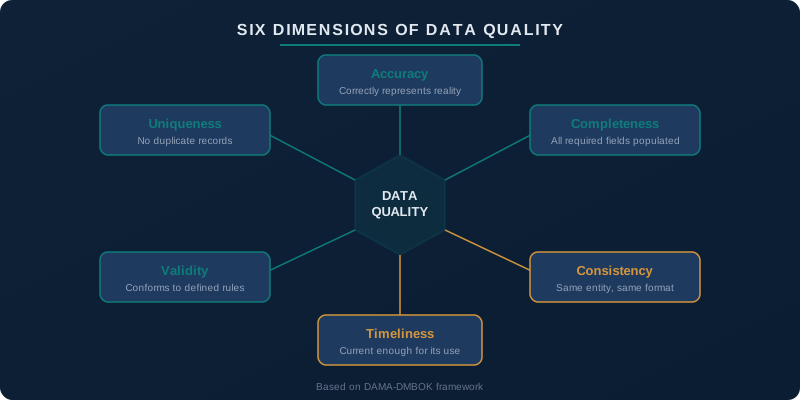
1. Accuracy
Does the data correctly represent the real-world entity or event it describes? Inaccurate data, whether it's wrong addresses, miscategorized transactions, or mislabeled training samples, directly corrupts model outputs.
The fix: Implement validation rules at the point of ingestion. Cross-reference critical data fields against authoritative sources. Run regular accuracy audits for high-impact datasets.
2. Completeness
Are all required data fields populated? Missing values force models to make assumptions, and those assumptions are often wrong. A customer record missing industry classification or a sensor reading with gaps in timestamps will degrade every downstream analysis.
The fix: Define completeness thresholds for each dataset. Monitor fill rates in real time and alert when they drop below acceptable levels.
3. Consistency
Does the same entity have the same representation across systems? When "IBM," "International Business Machines," and "I.B.M." all appear in your CRM, your model treats them as three different companies.
The fix: Establish master data management practices for critical entities. Build entity resolution pipelines that standardize records before they reach analytics or training datasets.
4. Timeliness
Is the data current enough for its intended use? A fraud detection model trained on data that's six months stale will miss emerging attack patterns. A recommendation engine using last quarter's inventory data will suggest products that are out of stock.
The fix: Define freshness SLAs for each dataset based on its use case. Move critical pipelines from batch to near-real-time where the business case justifies it.
5. Validity
Does the data conform to defined formats and business rules? An age field containing negative numbers, a date field with impossible values, or a currency field mixing formats. These aren't just messy. They're dangerous inputs for ML models.
The fix: Enforce schema validation at every pipeline boundary. Use tools like Great Expectations or dbt tests to codify business rules and continuously check them against incoming data.
6. Uniqueness
Are there duplicate records? Duplicates inflate metrics, skew model training distributions, and lead to incorrect business decisions. A customer appearing three times in your dataset gets three times the weight in any model trained on it.
The fix: Implement deduplication at ingestion and run periodic sweeps across your data warehouse. Use probabilistic matching for fuzzy duplicates that share similar but not identical attributes.
Building Quality Into the Pipeline
The biggest mistake enterprises make is treating data quality as a one-time cleanup project. You spend three months cleaning a dataset, train a model on it, and six months later the data has degraded right back to its original state.
Quality has to be a continuous process baked into your pipelines.
Shift left. Validate data as close to the source as possible. Don't wait until it reaches your data warehouse to discover problems.
Automate testing. Treat data pipelines like software with automated tests that run on every load. Check for schema changes, volume anomalies, distribution shifts, and business rule violations.
Assign ownership. Every critical dataset needs a data owner who is accountable for its quality. Without clear ownership, quality degrades because nobody feels responsible.
Measure and report. Create data quality dashboards that make metrics visible to stakeholders. What gets measured gets managed.
Why This Matters for AI
Data quality has compounding effects on AI systems. A model trained on low-quality data doesn't just produce slightly wrong outputs. It produces confidently wrong outputs. And once stakeholders lose trust in a model's predictions, rebuilding that trust takes far longer than getting it right the first time.
Research from MIT's Chief Data Officer and Information Quality program consistently shows that organizations investing in data quality before AI deployment see dramatically higher success rates.
The Bottom Line
Data quality is not a data engineering problem. It's a strategic imperative. Before launching your next AI initiative, invest in understanding the quality of your data across all six dimensions. The return on data quality improvement is immediate, measurable, and compounds with every model and analysis built on top of it.
If your AI models aren't delivering results, the answer might not be a better algorithm. It might be better data.
Want to discuss this topic?
Book a free consultation with our team to explore how these insights apply to your organization.