FinOps for Multi-Cloud: Controlling Costs Without Sacrificing Performance
The Cloud Cost Problem Is Getting Worse
Cloud cost overruns have become one of the most common frustrations for enterprise technology leaders. Flexera's annual State of the Cloud report consistently shows that organizations estimate they waste around 30% of their cloud spend. And as more workloads move to the cloud, including GPU-heavy AI infrastructure, the absolute dollar amounts are growing fast.
The problem isn't that cloud is expensive. It's that most organizations don't have the practices, tooling, or accountability structures needed to manage cloud spending effectively.
That's where FinOps comes in.
What FinOps Is (and Isn't)
FinOps, as defined by the FinOps Foundation, is an operational framework for managing cloud costs. It's not a tool or a cost-cutting exercise. It's a cultural practice that brings financial accountability to cloud spending.
The framework has three phases.
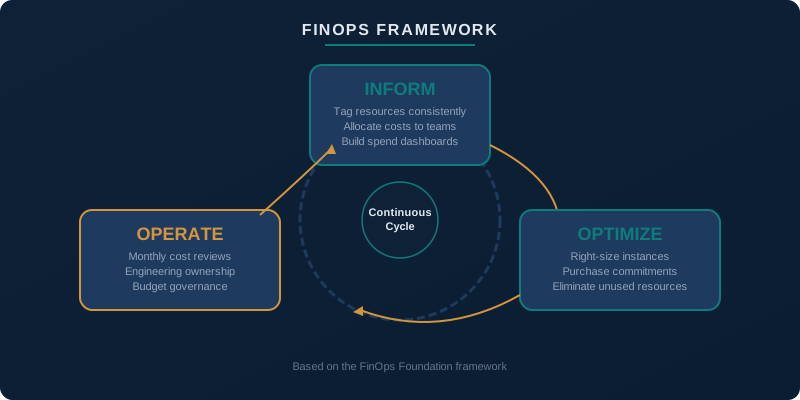
Inform. Give teams visibility into what they're spending and why. This means tagging resources consistently, allocating costs to business units, and building dashboards that show spend trends at a granular level. You can't optimize what you can't see.
Optimize. Once you know where the money is going, reduce waste. Right-size overprovisioned instances. Purchase reserved capacity for predictable workloads. Use spot or preemptible instances for fault-tolerant jobs. Eliminate unused resources.
Operate. Build the organizational muscle to maintain cost discipline over time. This means regular cost reviews, clear ownership of spending decisions, and processes that prevent waste from creeping back in.
The Multi-Cloud Challenge
FinOps is hard enough with a single cloud provider. When you're running workloads across AWS, Azure, and GCP (as most large enterprises are), the complexity multiplies.
Each provider has different pricing models, different discount mechanisms, and different billing structures. An AWS Reserved Instance works differently from an Azure Savings Plan, which works differently from GCP Committed Use Discounts. Comparing costs across providers requires normalizing data that each provider reports differently.
Tagging consistency becomes critical and much harder across providers. You need a unified tagging strategy that works across all three clouds and gets enforced at provisioning time.
Cost allocation requires a central view that aggregates spending from multiple billing accounts across providers. Tools like CloudHealth, Cloudability, or open-source options like OpenCost can help, but they require investment to configure and maintain.
Discount optimization for each provider needs to be managed separately, since commitments don't transfer between providers. This means dedicated analysis for each cloud to ensure you're maximizing discounts where they make sense.
The GPU and AI Cost Problem
The newest and fastest-growing challenge in cloud cost management is AI infrastructure. GPU instances cost 10 to 50 times more per hour than standard compute. A single training run on a cluster of A100 GPUs can cost tens of thousands of dollars. And because AI workloads are often experimental, it's easy for costs to spiral before anyone notices.
Specific strategies for AI cost management:
Right-size GPU selection. Not every workload needs the latest and most expensive GPU. Inference workloads can often run on smaller instances. Fine-tuning doesn't always require the same hardware as training from scratch.
Use spot instances for training. Training workloads that checkpoint progress regularly can take advantage of spot pricing at significant discounts. This requires engineering your training pipelines to handle interruptions, but the savings are substantial.
Monitor utilization aggressively. GPU utilization rates below 50% are common and represent pure waste. Monitor GPU utilization at the job level and investigate low-utilization patterns.
Set budgets and alerts. AI teams should have clear spending limits and automated alerts when they're approaching thresholds. A $50,000 surprise GPU bill is avoidable with basic guardrails.
Building the FinOps Organization
FinOps doesn't work as a one-person initiative. It requires collaboration between engineering, finance, and business teams.
The FinOps team (often 2 to 5 people in a large enterprise) sets standards, builds tooling, provides cost visibility, and facilitates optimization decisions. They don't own the spending. They enable the people who do.
Engineering teams own the spending for their services. They make the technical decisions about instance types, scaling policies, and architecture that ultimately determine cost. FinOps gives them the visibility and recommendations to make those decisions well.
Finance teams provide budget context, forecasting, and reporting. They help translate cloud spending into business terms that executives can act on.
The most effective FinOps practices we've seen share a common trait: regular (usually monthly) cost reviews where engineering and finance sit together, review the numbers, and agree on optimization actions. This single practice, consistently executed, drives more cost savings than any tool.
Where to Start
If you're just beginning your FinOps journey, focus on the basics:
- Tag everything. Implement a consistent tagging policy and enforce it at provisioning time.
- Build visibility. Get a cost dashboard that shows spending by team, service, and environment.
- Eliminate waste. Find and shut down unused resources. This is almost always the easiest win.
- Right-size. Review your top 20 most expensive resources and check if they're appropriately sized.
- Buy commitments. For stable, predictable workloads, purchase reserved or committed use discounts.
These five steps alone can reduce cloud spend by 20 to 30 percent in most organizations. From there, you can build toward more sophisticated optimization and governance practices.
Want to discuss this topic?
Book a free consultation with our team to explore how these insights apply to your organization.