Measuring AI ROI: A Practical Framework for Enterprise Leaders
The AI ROI Problem
Enterprise AI spending is accelerating. Budgets are growing. Pilot projects are multiplying. But when the board asks "what's the return on our AI investment?", most organizations struggle to give a clear answer.
This isn't because AI doesn't deliver value. It's because the traditional ROI frameworks designed for IT infrastructure and software projects don't map cleanly to AI initiatives. AI value is often indirect, distributed across multiple processes, and realized over longer time horizons than executives expect.
McKinsey's research on AI's economic potential consistently finds that the organizations capturing the most value from AI are the ones that have figured out how to measure it. Measurement isn't just reporting. It's the mechanism that connects AI investments to business outcomes and guides where to invest next.
Why Traditional ROI Fails for AI
Standard ROI calculations compare the cost of an investment against its direct financial returns. For a new ERP system, you can measure implementation cost against efficiency gains. The math is relatively straightforward.
AI is different in three ways.
Value is often indirect. An AI model that improves demand forecasting doesn't directly generate revenue. It reduces overstock, decreases markdowns, and improves fill rates, which together improve margins. The causal chain between the AI investment and the financial outcome has multiple links, making attribution difficult.
Payoff timelines vary. Some AI use cases show returns in weeks. Others require months of data collection, model iteration, and process change before they deliver meaningful value. Evaluating a six-month-old AI project with the same timeline expectations as a software deployment leads to premature disappointment.
The counterfactual is hard to measure. How do you quantify the value of a fraud detection model that prevented losses? You're measuring something that didn't happen. This makes the "return" side of ROI inherently more ambiguous than for traditional projects.
A Three-Tier Framework
Rather than trying to force AI into a single ROI number, we've found it more useful to evaluate AI value across three tiers.
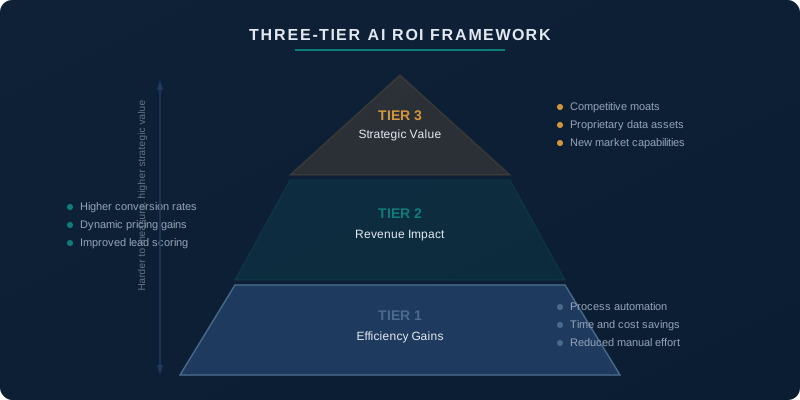
Tier 1: Efficiency Gains
This is the most straightforward tier. AI automates or accelerates existing processes, and you can measure the time or cost saved.
Examples:
- Document processing that reduces manual review time from 4 hours to 20 minutes per batch.
- Customer service chatbots that resolve 40% of inquiries without human escalation.
- Predictive maintenance that reduces unplanned downtime by 25%.
How to measure: Establish a baseline before deployment. Measure the same metric after deployment. Calculate the cost of the labor, time, or resources saved. This is your Tier 1 return.
Common pitfall: Don't count theoretical capacity freed up unless that capacity is actually redeployed to productive work. If you save 100 analyst-hours per month but those analysts just do other low-value work, the real return is lower than it appears.
Tier 2: Revenue Impact
This tier captures AI initiatives that generate new revenue or measurably improve existing revenue streams.
Examples:
- Recommendation engines that increase average order value by 12%.
- Dynamic pricing models that optimize margins across product lines.
- Lead scoring that improves sales conversion rates by prioritizing the right prospects.
How to measure: Run controlled experiments where possible. A/B test the AI-powered experience against the existing one. Measure the difference in revenue metrics. For long-running initiatives, use time-series analysis with appropriate controls for seasonality and other confounding factors.
Common pitfall: Attribution. Revenue improvements rarely come from a single source. A higher conversion rate might be partly due to AI-powered personalization and partly due to a pricing change that happened at the same time. Be rigorous about isolating the AI contribution.
Tier 3: Strategic Value
This is the hardest to quantify but often the most important. Strategic value captures AI investments that create competitive advantages, build defensible data assets, or enable capabilities that would be impossible without AI.
Examples:
- Proprietary models trained on your unique data that competitors can't replicate.
- AI-powered products that create new market categories or customer segments.
- Data infrastructure investments that make future AI initiatives faster and cheaper to deploy.
How to measure: Use qualitative frameworks rather than precise financial calculations. Assess competitive position: does this capability create a moat? Measure speed of future AI deployment: is the organization getting faster at shipping AI products? Survey customers: is the AI-powered experience a differentiator in their purchase decisions?
Common pitfall: Using strategic value as a justification to avoid measurement entirely. Even strategic investments should have defined milestones and checkpoints to validate that the thesis is proving out.
Setting Up for Measurement
The best time to define your measurement approach is before you start the AI project, not after. Here's what to establish upfront:
Baseline metrics. Measure the current state of whatever you're trying to improve before deploying the AI solution. Without a baseline, you'll be arguing about the impact after the fact.
Success criteria. Define what success looks like at 3, 6, and 12 months. Make these specific and measurable.
Attribution model. Decide in advance how you'll attribute improvements to the AI initiative versus other changes happening simultaneously. This prevents post-hoc debates about what caused the improvement.
Total cost of ownership. Include all costs: infrastructure, data preparation, model development, monitoring, maintenance, and the opportunity cost of the team's time. AI projects frequently underestimate ongoing operational costs.
Communicating AI ROI to the Board
Executive audiences care about three things: how much was spent, what it delivered, and whether to invest more.
Structure your reporting around those questions. Lead with business outcomes, not technical metrics. "Our demand forecasting model reduced inventory carrying costs by $2.3M annually" is more useful in a board conversation than "we achieved 94% prediction accuracy."
And be honest about what you're still learning. AI programs that acknowledge uncertainty and show a clear plan for improving measurement over time build more executive confidence than ones that claim precise ROI numbers that don't hold up to scrutiny.
Moving Forward
AI ROI is not a single number. It's a portfolio view across efficiency, revenue, and strategic value. Building the measurement muscle takes time, but the organizations that invest in it gain a significant advantage: the ability to direct AI spending toward the initiatives with the highest proven returns, rather than relying on intuition and hope.
Start with the easy wins in Tier 1 to build measurement credibility. Then extend your framework to capture revenue and strategic value as your AI program matures.
Want to discuss this topic?
Book a free consultation with our team to explore how these insights apply to your organization.