Platform Engineering: Building an Internal Developer Platform That Scales
The DevOps Bottleneck
DevOps promised to break down silos between development and operations. And it did, to a point. But in many enterprises, what actually happened was that developers inherited a pile of infrastructure responsibilities on top of their existing work. Configure your own CI/CD pipelines. Write your own Terraform. Debug your own Kubernetes manifests.
The result is a lot of developers spending a lot of time on tasks that aren't writing application code. Gartner estimates that by 2026, 80% of software engineering organizations will have established platform teams. The reason is straightforward: developer productivity is suffering, and platform engineering is the most practical solution.
What Platform Engineering Actually Means
Platform engineering is the discipline of designing and building internal developer platforms (IDPs) that make it easy for application teams to build, deploy, and operate software without needing to become infrastructure experts.
Think of it as a product team, except the product is the developer experience within your organization. The platform team builds and maintains the tooling, automation, and guardrails that application teams use every day.
The CNCF Platforms White Paper defines a good platform by what it provides:
Golden paths. Opinionated, pre-built workflows for common tasks like spinning up a new service, deploying to production, or provisioning a database. Developers follow the path and get a working, compliant, observable service without making dozens of infrastructure decisions.
Self-service capabilities. Developers can provision what they need without filing tickets or waiting for another team. This doesn't mean giving everyone admin access. It means building well-scoped interfaces that let developers do what they need within safe boundaries.
Abstractions, not restrictions. The platform hides complexity rather than exposing it. A developer doesn't need to write Kubernetes YAML to deploy a service. They describe what they want, and the platform handles the how.
The Components of a Modern IDP
While every platform is different, most mature IDPs include these building blocks.
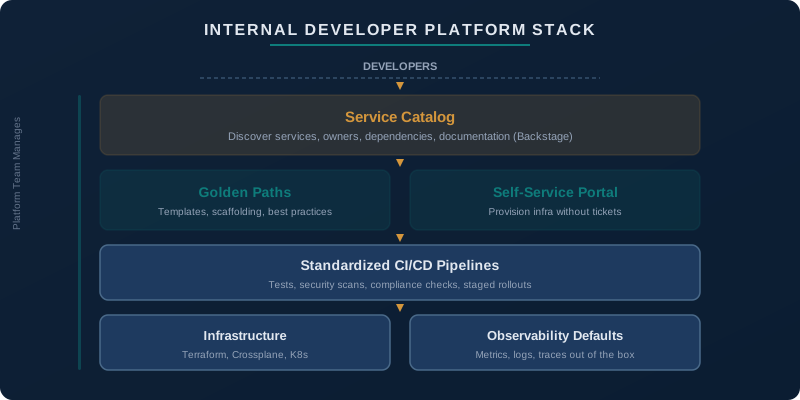
Service Catalog
A registry of every service in the organization, who owns it, what it depends on, and how to contact the team. Tools like Backstage (originally from Spotify) have become the standard starting point. A good service catalog eliminates the "who owns this?" problem that plagues large organizations.
Deployment Pipelines
Standardized CI/CD pipelines that enforce your organization's quality gates: tests, security scans, compliance checks, and staged rollouts. Application teams plug into the pipeline rather than building their own from scratch.
Infrastructure Provisioning
Self-service interfaces for provisioning infrastructure: databases, message queues, storage buckets, monitoring dashboards. This is where tools like Terraform, Crossplane, or cloud-native provisioning APIs sit behind a developer-friendly interface.
Observability Defaults
Every service deployed through the platform gets monitoring, logging, and tracing out of the box. Developers don't need to configure Prometheus scraping or set up log forwarding. The platform handles it.
Measuring Platform Success
Building a platform is meaningless if developers don't use it or if it doesn't improve outcomes. Track these metrics:
Time to first deploy. How long does it take a new developer or a new service to go from zero to running in production? This is the single best indicator of platform effectiveness.
Developer satisfaction. Survey your developers regularly. Do they find the platform helpful? What's frustrating? What's missing? If developers are working around the platform rather than through it, something is wrong.
Deployment frequency. Are teams shipping more often? A good platform reduces the friction of deployment, which should naturally lead to smaller, more frequent releases.
Incident recovery time. Does the platform's built-in observability help teams diagnose and resolve issues faster?
Anti-Patterns to Avoid
Building too much before shipping. Platform teams that spend a year building in isolation before releasing anything to developers almost always build the wrong thing. Start with one golden path that solves one real problem. Ship it. Get feedback. Iterate.
Mandating adoption. The best platforms win through developer experience, not through mandates. If developers prefer to work around your platform, that's a signal that the platform isn't solving their problems. Fix the product, don't force adoption.
Ignoring the developer feedback loop. Treat your platform like a product. Run user research. Prioritize based on developer needs. Have a roadmap and communicate it. Platform teams that operate like internal IT departments rather than product teams struggle to maintain relevance.
Over-abstracting. Abstractions are powerful but they have limits. If a developer needs to eject from the platform to handle an edge case, the ejection path should be clear and documented. Don't trap people in an abstraction that doesn't fit their use case.
Getting Started
If your organization doesn't have a platform team yet, start small. Identify the most common developer friction points (usually deployment and environment provisioning), build a thin automation layer that addresses them, and assign a small team to own and improve it.
The goal isn't to build a perfect platform on day one. It's to start the feedback loop between your platform team and your developers. Everything follows from that.
Want to discuss this topic?
Book a free consultation with our team to explore how these insights apply to your organization.