Real-Time Analytics Architecture: From Batch to Streaming
The Batch Processing Ceiling
For decades, most enterprise analytics ran on a simple rhythm. Data gets collected during the day, ETL jobs process it overnight, and dashboards refresh by morning. It worked. But as business expectations accelerate and competitive windows shrink, waiting until tomorrow for yesterday's data is becoming a real liability.
Fraud detection, dynamic pricing, supply chain optimization, personalized recommendations. These use cases demand data that is minutes or seconds old, not hours. The question isn't whether to adopt streaming. It's how far to go and where to start.
Understanding the Architecture Spectrum
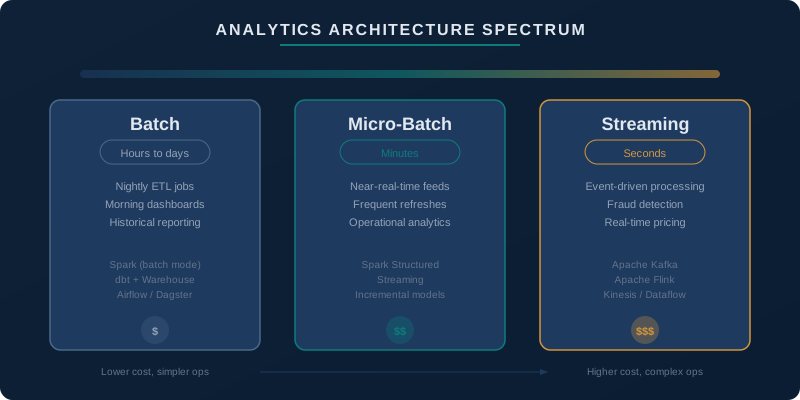
Real-time analytics isn't a binary choice. There's a spectrum, and understanding where your use cases fall on it is the first step.
Traditional batch. Data arrives in bulk, gets processed on a schedule (hourly, daily), and lands in a warehouse. Good for historical reporting and retrospective analysis. Low operational complexity.
Micro-batch. Processing runs every few minutes instead of once a day. Tools like Spark Structured Streaming make this approachable. You get near-real-time freshness without the full complexity of event streaming.
True streaming. Events are processed individually as they arrive, typically through Apache Kafka or Apache Flink. Latencies drop to seconds or sub-seconds. This is what you need for fraud detection, real-time bidding, or live operational dashboards.
The right choice depends on what your business actually needs. Not every dashboard needs to update every second, and overbuilding your streaming infrastructure is an expensive mistake.
Lambda vs. Kappa: Picking an Architecture Pattern
Two architectural patterns dominate the conversation around streaming analytics.
Lambda architecture maintains two parallel pipelines. A batch layer handles historical reprocessing and ensures accuracy. A speed layer handles real-time events for low-latency queries. Results from both layers get merged at query time. It's reliable but operationally complex because you're maintaining two separate codebases that need to produce consistent results.
Kappa architecture, originally proposed by Jay Kreps at Confluent, simplifies this by treating everything as a stream. Historical reprocessing happens by replaying the event log rather than running a separate batch pipeline. You get one codebase, one processing paradigm, and significantly less operational overhead. The tradeoff is that you need a robust, scalable event log (Kafka, in most cases) that can retain and replay large volumes of data.
For most enterprises starting their streaming journey, Kappa is the more practical choice. Lambda makes sense when you have legacy batch systems that can't be easily replaced and need to run in parallel during a transition period.
The Technology Landscape
The streaming ecosystem has matured significantly in recent years.
Apache Kafka remains the backbone for event streaming. It handles ingestion, buffering, and distribution of event data at scale. Managed offerings from Confluent, AWS (MSK), and Azure (Event Hubs with Kafka protocol) reduce operational burden.
Apache Flink has emerged as the leading stream processing engine for complex event processing, windowed aggregations, and stateful computations. Its exactly-once processing guarantees make it suitable for financial and transactional workloads.
Spark Structured Streaming provides a gentler on-ramp for teams already invested in the Spark ecosystem. It's well-suited for micro-batch workloads and integrates naturally with existing Spark-based data pipelines.
Managed options like AWS Kinesis, Google Dataflow, and Azure Stream Analytics lower the barrier to entry but come with vendor lock-in tradeoffs that enterprises should evaluate carefully.
When Real-Time Actually Matters
Before investing in streaming infrastructure, run each use case through a simple test. Ask: "What happens if this data is five minutes old? An hour old? A day old?"
If the answer is "nothing changes," batch is fine. Don't build streaming infrastructure for use cases where near-real-time doesn't change the decision or outcome.
Where real-time consistently matters:
- Fraud and anomaly detection. Every minute of delay is a minute of exposure.
- Operational monitoring. System health, SLA tracking, and alerting need current data.
- Customer-facing personalization. Recommendations and pricing that react to user behavior in the moment.
- Supply chain and logistics. Inventory visibility, shipment tracking, and demand sensing.
Where batch is usually sufficient:
- Financial reporting and regulatory submissions
- Monthly business reviews and strategic dashboards
- Historical trend analysis and long-range forecasting
The Cost Reality
Streaming infrastructure is meaningfully more expensive to build and operate than batch. Kafka clusters need to run continuously. Flink jobs consume compute around the clock. Monitoring and alerting become more complex. Your team needs different skills.
A reasonable approach is to start with one or two high-value streaming use cases, prove the ROI, and expand from there. Don't try to move your entire data platform to streaming at once.
Moving Forward
The transition from batch to streaming is a journey that most enterprises will make incrementally over several years. The key is being deliberate about which workloads justify real-time processing and which are perfectly well served by batch.
Start by cataloging your analytics use cases and mapping each one to the freshness level it actually requires. That exercise alone will clarify where streaming investments will generate the most value and where you can avoid unnecessary complexity.
Want to discuss this topic?
Book a free consultation with our team to explore how these insights apply to your organization.