Zero Trust Architecture: A Practical Implementation Roadmap
Beyond the Buzzword
Zero trust has become one of the most overused terms in enterprise security. Every vendor claims to sell it. Every CISO is asked about it. And yet most organizations struggle to define what zero trust actually means for their specific environment, let alone implement it.
At its core, zero trust is a security model that assumes no user, device, or network should be inherently trusted. Every access request must be verified, regardless of where it originates. NIST SP 800-207 provides the canonical definition, and CISA's Zero Trust Maturity Model gives organizations a practical way to measure progress.
The challenge is not understanding the concept. The challenge is turning it into a concrete implementation plan that works with your existing infrastructure, budget constraints, and organizational dynamics.
The Five Pillars
CISA's maturity model breaks zero trust into five pillars. Understanding these helps you plan your implementation in focused, manageable phases.
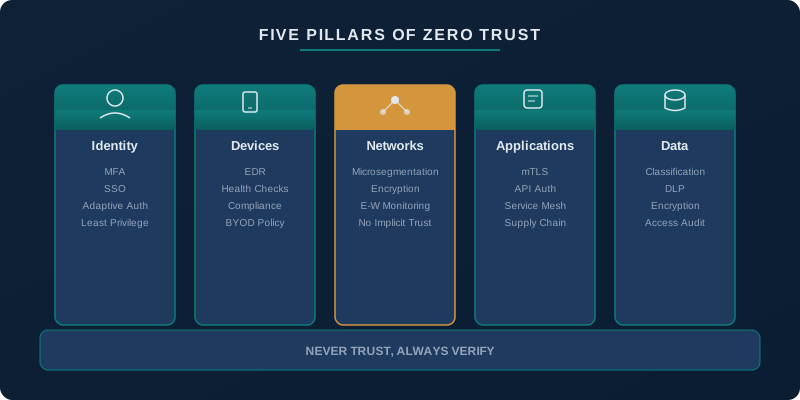
1. Identity
This is where most organizations should start, because identity is the foundation everything else depends on. If you don't know who is accessing your systems and whether they should be, nothing else matters.
Key actions:
- Deploy multi-factor authentication for all users, not just privileged accounts.
- Implement single sign-on to centralize authentication and improve visibility.
- Move toward risk-based, adaptive authentication that evaluates context (location, device, behavior) for every access request.
- Conduct regular access reviews to remove stale permissions. Aim for least privilege as the default.
2. Devices
A verified user on a compromised device is still a risk. Zero trust requires confidence that the device accessing your resources meets your security baseline.
Key actions:
- Deploy endpoint detection and response (EDR) on all managed devices.
- Implement device health checks as a condition for access. If a device is missing patches or has disabled security tools, restrict what it can reach.
- Develop a strategy for unmanaged devices (contractors, BYOD). Consider virtual desktop infrastructure or browser isolation for high-risk scenarios.
3. Networks
Traditional network security relies on perimeter defenses: trusted inside, untrusted outside. Zero trust eliminates that distinction. The network is always untrusted.
Key actions:
- Implement microsegmentation to limit lateral movement. If an attacker compromises one system, they shouldn't be able to freely access the rest of the network.
- Encrypt all traffic, including east-west traffic within your data centers.
- Deploy network monitoring that can detect anomalous communication patterns between internal systems.
4. Applications
Applications and workloads need their own access controls, independent of network-level protections.
Key actions:
- Authenticate and authorize every API call between services. Mutual TLS and service mesh architectures make this manageable at scale.
- Implement application-level access controls based on user identity, device posture, and context.
- Protect against supply chain risks in your application dependencies through software composition analysis and container image scanning.
5. Data
Ultimately, zero trust exists to protect data. All other pillars are in service of controlling who can access what data and under what conditions.
Key actions:
- Classify your data by sensitivity. You can't protect what you haven't categorized.
- Implement data loss prevention (DLP) controls that monitor and restrict data movement based on classification.
- Encrypt sensitive data at rest and in transit. Manage encryption keys centrally.
- Log and audit all access to sensitive data stores.
A Phased Roadmap
The biggest mistake organizations make is trying to implement zero trust across all five pillars simultaneously. That's a recipe for initiative fatigue and budget exhaustion.
Phase 1: Foundation (Months 1 to 6)
Focus exclusively on identity. This delivers the most security value with the least disruption.
- Roll out MFA across the entire organization.
- Implement SSO for all critical applications.
- Deploy a privileged access management solution for admin and service accounts.
- Conduct an access review to right-size permissions.
- Establish an identity governance process for joiners, movers, and leavers.
Phase 2: Visibility (Months 6 to 12)
Before you can enforce zero trust on devices and networks, you need to see what's out there.
- Deploy EDR to all endpoints and establish a device compliance baseline.
- Inventory all network communication patterns between systems. Understand normal before you start restricting.
- Implement centralized logging across identity, endpoint, and network events.
Phase 3: Segmentation (Months 12 to 18)
Start restricting access based on the visibility you've built.
- Implement microsegmentation for your most critical applications and data stores.
- Enforce device compliance as a condition for access to sensitive resources.
- Deploy application-level authentication between internal services.
Phase 4: Continuous Verification (Months 18 to 24)
Move from point-in-time checks to continuous assessment.
- Implement continuous access evaluation that reassesses trust throughout a session, not just at login.
- Deploy behavioral analytics that detect anomalous user and device activity.
- Automate response actions for policy violations (session termination, step-up authentication, quarantine).
Getting Executive Buy-In
Zero trust is a multi-year journey that requires sustained investment. Here's what resonates with leadership:
Frame it as risk reduction, not technology. Executives care about business risk, not network architecture. Show how zero trust reduces the impact of the most likely attack scenarios your organization faces.
Show incremental value. Each phase delivers measurable security improvements. Don't present it as all-or-nothing.
Quantify the cost of not acting. Reference recent breaches that exploited the exact gaps zero trust addresses: compromised credentials, lateral movement, over-permissioned accounts. These stories are unfortunately easy to find.
The Bottom Line
Zero trust is achievable, but only if you approach it as a structured, multi-phase program rather than a product purchase. Start with identity. Build visibility. Add restrictions incrementally. And measure your maturity against CISA's model so you can demonstrate progress to stakeholders.
The organizations that succeed with zero trust are the ones that treat it as a continuous improvement program, not a project with an end date.
Want to discuss this topic?
Book a free consultation with our team to explore how these insights apply to your organization.